
Catalogue of Type Specimens in the MCNS Herbarium, Universidad Nacional de Salta (Argentina)
Catálogo de los Ejemplares Tipo del Herbario
MCNS, Universidad Nacional
de Salta (Argentina)
Olga G. Martínez & Marcelo
Gerónimo
Herbario
MCNS, Facultad de Ciencias Naturales, Universidad Nacional de Salta,
Av. Bolivia 5150 (A4408FVL) Salta. Argentina. herbariomcns@gmail.com, martinezog@gmail.com
This article presents
a catalogue of the collection of holotypes and isotypes held at the MCNS herbarium of the Facultad de Ciencias Naturales, Universidad Nacional de Salta, Argentina. The collection includes 17 holotypes and 12 isotypes, corresponding to four families of ferns (Cyatheaceae, Dryopteridaceae, Polypodiaceae, and Pteridaceae) and 15 families
of angiosperms (Amaryllidaceae, Apiaceae, Asteraceae, Bignoniaceae, Brassicaceae, Bromeliaceae, Crassulaceae, Fabaceae, Francoaceae, Juncaceae, Malvaceae, Meliaceae, Rubiaceae, Salicaceae, and Solanaceae). For each specimen,
the collection number
of the herbarium, collection data and bibliographic reference in which it was cited as nomenclatural type are provided;
four digitized images of type specimens
are also included.
Key words: Botanical
Collection; Botanical Nomenclature; Holotype; Isotype;
Se presenta
un catálogo de la colección de los holo e Isotipos
preservados en el herbario MCNS de la Facultad de Ciencias Naturales (Universidad Nacional de Salta,
Argentina). La colección comprende 17 holotipo s y 12 isotipos correspondientes a cuatro familias
de helechos (Cyatheaceae, Dryopteridaceae, Polypodiaceae, y Pteridaceae) y 15 familias
de angiospermas (Amaryllidaceae, Apiaceae, Asteraceae, Bignoniaceae, Brassicaceae, Bromeliaceae, Crassulaceae, Fabaceae, Francoaceae, Juncaceae, Malvaceae, Meliaceae, Rubiaceae, Salicaceae, y Solanaceae). Para cada ejemplar se incluye el número de colección del herbario, datos
de colección y la publicación donde fue citado como tipo nomenclatural; además, se ilustra con cuatro imágenes digitalizadas de ejemplares tipo.
Palabras clave: Colección
Botánica; Holotipo;
Isotipo; Nomenclatura Botánica.

Martínez, O. G., &
Gerónimo M. (2025).
Catalogue of Type Specimens
in
the MCNS Herbarium, Universidad Nacional
de Salta (Argentina) Revista
Ciencias Naturales
3(2), 107-118. https://id.caicyt.gov.ar/ark:/s29535441/y0ev5c0to
Recibido: 14/09/2025 Aceptado: 15/12/2025
Publicado: 18/12/2025 Editor: Ricardo Alonso
INTRODUCTION
The collection of the MCNS Herbarium of the Facultad de Ciencias Naturales, Universidad Nacional de Salta, Argentina, began in 1975 (Novara, 1991).
Initially, that collection was deposited at the Natural Sciences Museum of Salta, and was assigned
the acronym MCNS (Holmgren
et al., 1990).
At present, the herbarium is located on the premises
of the university campus.
The collection includes about 50,000 specimens from diverse regions of Salta province
and nearby areas. Most of the specimens
came from the contribution of regional
floristic studies, as well as from exchanges
and donations. In the last years,
the collection was enhanced mostly by research work on different fields, including biogeographical,
ethnobotanical, molecular, chemical, taxonomic, and toxicological studies.
Herbarium specimens are the only direct documented evidence of the flora of a region (Pandey & Kasana,
2021) and an inexhaustible source for botanical research, including anatomical, morphological, palynological (Espeche et al.,
2020), and chemical
studies (Peñuelas
& Matamala, 1993). Herbaria also provide evidence
to evaluate the historical
distribution of plants (Davis 2023).
A
vast number of institutions disseminate digitized images
of type specimens through
the platform JSTOR Global Plants
(https://plants. jstor.org/), or provide data through catalogues, such as Lira et al. (1996), Ocampo Acosta
& Medellín
Villamil (2004), Fernández- Fernández et al. (2015), and Peña Tamayo & Jaramillo Díaz (2019).
The aim of this contribution is to
disseminate information about the type, holotype and isotype specimens deposited
at the collection of the MCNS herbarium.
MATERIALS AND METHODS
This work is based on the review of type specimens, of which only holotyes
and isotyes were
selected. Specimens are organized
in separate shelves and digitized to facilitate future online consultation. There is a printed
copy of the protologue for each individual.
A catalogue with nomenclatural types is presented in alphabetical order of families, genera and species. For
each specimen, the following data are provided: published
scientific name; original
reference (Ref.); category of the type and record
number in the general herbarium; and collection data (province, department and locality, height
above sea level, collection date, collector name,
and collection number).
Specimens were digitized with a Canon EOS M200 camera.
RESULTS
The MCNS herbarium
holds 29 types, 17 holotypes and 12 isotypes,
belonging to four families of ferns (21 %) and 15 families
of angiosperms (79 %) (Fig.1A).
The holotypes
correspond to four fern
families: Cyatheacae, Dryopteridaceae, Polypodiaceae,
and Pteridaceae, and seven families
of angiosperms: Apiaceae, Asteraceae, Bromeliaceae, Crassulaceae, Francoaceae, Juncaceae, and Rubiaceae (Fig. 1B). The isotypes correspond to 11 families of angiosperms: Amaryllidaceae, Asteraceae, Bignoniaceae, Brassicaceae, Bromeliaceae,
Fabaceae, Juncaceae, Malvaceae, Meliaceae, Salicaceae and Solanaceae (Fig. 1C).
Most of the families have a single
nomenclatural type and three families have holotypes and isotypes:
Asteraceae, Bromeliaceae and Juncaceae.
Catalogue of type specimens
1. Ferns
À Cyatheaceae
Alsophila elata O. G. Martínez in Brittonia 67: 49. 2015.
Type: Holotype MCNS 12732.

Figure 1. Type specimens housed in the MCNS Herbarium. A. Percentage of ferns (light green) and angiosperms (dark green).
B. Families represented by holotypes and number of species
per family. C. Families represented by isotypes and
number of species per family.
Collection data:
Argentina. Salta: Dpto. Orán, Río Blanquito, S 22°34’20” W 64°40’21”, 1000 m s.n.m. 7-XII-2011.
Martínez O., Chambi J. & Guaymás H. 2294.
Ref.: Martínez O. G. (2015).
A new species of Alsophila
(Cyatheaceae) from the
Tucuman- Bolivian
forest. Brittonia 67(1), 48-55. https:// doi.org/10.1007/s12228-014-9355-z
À Dryopteridaceae
Polystichum lionelii O.G. Martínez
&
M.A. Hern. in Phytotaxa
619: 190. 2023. Type: Holotype
MCNS 13664.
Collection data: Argentina. Salta: Dpto. Santa Victoria, Nazareno, Paraje Mono Abra, 3700 m s.n.m. 28-III-2020. Serapio F. 120.
Ref.: Martínez
O. G., Hernández M. A., & Serapio, F. (2023).
Polystichum lionelii
(Dryopteridaceae), a new Andean species
from northwestern Argentina. Phytotaxa 619(2), 189-196. https://doi.org/10.11646/ phytotaxa.619.2.7
À Polypodiaceae
Pecluma barituensis O. G. Martínez & de
la Sota in Novon 17:
43. 2007.
Type: Holotype MCNS 14000.
Collection data: Argentina. Prov. Salta: Dpto. Santa Victoria,
Parque Nacional Baritú, 1500 m s.n.m. 14-VII-1999. Martínez O. G. &
de la Sota E. R. 693.
Ref.: Martínez,
O. G.,
& de la Sota, E. R. (2007). A new species of Pecluma
(Pteridophyta-Polypodiaceae). Novon, 17 (1),43-45. https://doi.org/10.3417/1055- 3177(2007)17[43,ANSOPP]2.0.CO;2
À Pteridaceae
Pteris exigua
O. G. Martínez
& J. Prado in Brittonia 63: 295. 2011.
Type: Holotype MCNS 14001.
Collection data: Argentina.
Jujuy: Dpto. Ledesma, Parque Nacional
Calilegua, RP 83, sendero
Bosque del Cielo, S 23°40.1′ W 64°54.0′, 1700 m s.n.m. 4-VII-2010. Martínez O. G. & Prado J. 1895.
Ref.: Martínez, O.G., & Prado J. (2011). Pteris exigua (Pteridaceae), a new endemic species
from tucumano-boliviano forests in Northwestern
Argentina. Brittonia 63(2), 295-299. https://doi.org/10.1007/ s12228-010-9166-9
Pteris sotae O. Martínez
in Phyotaxa
267: 291. 2016.
Type: Holotype MCNS 13999.
Collection data: Argentina. Salta: Dpto. Orán, Río Blanquito, a 200 m del
pueblo, 950 m s.n.m. 20-IX-2014. Martínez O. G., Jarsún A., Chambi
J. & Suárez C. 3876.
Ref.: Martínez O. G. (2016).
Pteris sotae (Pteridaceae), a new endemic
species from the flora argentina. Phytotaxa 267 (4), 291-295. http,//dx.doi.org/10.11646/phytotaxa.267.4.6
2. Angiosperms
À Amarillydaceae
Habranthus quilmesianus Ravenna in Onira 1(8): 54. 1988.
Type: Isotype MCNS 14021.
Collection data: Argentina. Salta: Dpto. Chicoana,
pie de la Cuesta del Obispo,
al borde de la ruta y de campos alambrados, ca. 2000 m s.n.m. 31-X-1980. Novara L. J. & Hoy
G. 1422.
Ref.: Ravenna,
P. F. (1988). New species
of South American
Habranthus and Zephyranthes (Amaryllidaceae). Onira 1,
53-56.
À Apiaceae
Eryngium incantatum Lucena, Novara & Cuezzo in Aportes Botánicos de Salta,
serie Misceláneas 1(9): 3. 2001.
Type: Holotype MCNS 14004.
Collection data: Argentina. Salta: Dpto. Chicoana, Valle Encantado, 3000-3200
m s.n.m. 13-III-1985. Novara
L. J. 4451.

Figure 2. Holotype of Vernonia novarae Cabrera
(MCNS 14002). Credit: B. Rodríguez.
Ref.: Lucena,
I. D., Novara,
L. J., & Cuezzo,
A. R.(h). 2001. Una nueva especie de Eryngium L. (Apiaceae, sect. Ebracteata Wolff) para la Argentina. Aportes Botánicos de Salta, serie Misceláneas 1(9), 1-8.
À Asteraceae
Baccharis cabrerae Ariza in Kurtziana
7: 187. 1973.
Type: Isotype MCNS 14018.
Collection data: Argentina. Salta: Dpto. Cafayate,
Cuesta del Alisal,
Cerro del Cajón. 8-I-1914. Rodríguez
R. 1276.
Ref.: Ariza Espinar, L. (1973) Novedades sobre Baccharis (Compositae) de Argentina
III. Kurtziana 7,
187-193.
Vernonia novarae
Cabrera in Hickenia
2(54): 255. 1997.
Type: Holotype MCNS 14002. (Fig. 2) Collection
data: Argentina. Salta: Dpto. Santa Victoria, Parque Nacional Baritú,
faldeo al E de la Sierra del Porongal,
entre Quebrada La Gateada y Quebrada
Seca, 1400-1800 m s.n.m.
20-IX-1990. Novara
L. J. 9993.
Ref.: Cabrera,
A. L. (1997). Una nueva especie de Vernonia (Compositae) del este de Salta, Argentina. Hickenia 2,
255-256.
À Bromeliaceae
Puya novarae G.S. Varad. ex Gómez Rom. & A. Grau in Boletín
de la Sociedad Argentina de Botánica 44(1-2):
189. 2009.
Type: Isotype MCNS 14026.
Collection data: Argentina. Salta: Dpto. Santa Victoria, from 30 km SW of Santa Victoria, aprox.
S 22°10’W 65°07’, 2600-4050 m s.n.m. 13-V-1987. Varadarajan G. S. 1477.
Ref.: Gómez, S. E., & Grau, A. (2009). Las especies de Puya (Bromeliaceae) en la Argentina. Boletín de la Sociedad
Argentina de Botánica, 44(1-2), 175-208.
Tillandsia colorata f. flavescens L. Hrom. in Die Bromelie 1: 21. 2009.
Type: Holotype MCNS 14012.
Collection data: Argentina. Salta: Dpto. Cafayate,
Quebrada Colorada,
1700 m s.n.m. 26-VII-1981. Hromadnik H. 7202.
Ref.: Hromadnik, L. (2009). Tillandsia colorata
- eine neue,
kleine Tillandsia
aus der Verwandtschaft von Tillandsia argentina. Die Bromelie, 2009(1), 17-24.
Tillandsia colorata L. Hrom. in Die Bromelie 1: 20. 2009.
Type: Holotype MCNS 14011. Collection data: Argentina. Salta: Dpto.
Cafayate, Quebrada Colorada,
1700 m s.n.m. 26-VII-1981. Hromadnik H. 7201.
Ref.: Hromadnik, L. (2009). Tillandsia colorata
- eine neue,
kleine Tillandsia
aus der Verwandtschaft von Tillandsia argentina. Die Bromelie, 2009(1), 17-24.
Tillandsia guasamayensis Palací & Gilmartin in Systematic
Botany 14(2): 152, 1989.
Type: Holotype MCNS 14010.
Collection data:
Argentina. Jujuy: Dpto. Tilcara, Garganta del Diablo,
saxicolous on rocky outcrops
at river Guasamayo, 2800 m
s.n.m. 15-X-1986. Palací
C. 777.
Ref.: Palací C.
A., & Gilmartin, A. J. (1989) A New Species of Tillandsia (Bromeliaceae) from Northwest Argentina. Systematic Botany 14(2), 152-154.
https://doi. org/10.2307/2418902
Tillandsia markusii L. Hrom. in Die Bromelie
2002(3): 67.
Type: Holotype MCNS 14007.
Collection data: Argentina. Salta: Dpto. Molinos, prope pagum Brealito, 2700 m s.n.m. 23-VII-1981. Hromadnik H. 7156.

Figure 3. Holotype of Luzula castellanosii Barros (MCNS 14006). Credit: B. Rodríguez.
Ref.: Hromadnik, L. (2002). Tillandsia markusii L. Hromadnik, spec. nov. Die Bromelie 2002(3), 67-70.
Tillandsia rosarioae L. Hrom. in Die Bromelie 2: 50. 2005.
Type: Holotype MCNS 14013.
Collection data: Argentina.
Salta: Dpto. Cafayate, in montibus
septentrionaliter- occidentalibus vallis, Quebrada de las Conchas, 1900 m s.n.m. 1983. Rausch W. s.n.
Ref.: Hromadnik, L. (2005). Eine neue kleine Tillandsia aus Argentinien, Tillandsia rosarioae. Die Bromelie
2005(1), 49-51.
Tillandsia zecheri var. cafayatensis Palací & G. K. Br. in Journal of the Bromeliad Society 44: 113.
1994.
Type: Holotype MCNS 14008.
Collection data: Argentina. Salta: Dpto. Guachipas,
Garganta del Diablo, 1500 m s.n.m. 4-IV-1986.
Palací C. 534.
Ref.: Palací, C. A., & Brown, G. K. (1994). The Tillandsia zecheri complex and a new infraspecefic taxa from northwestern Argentina. Journal of the Bromeliad Society, 44,
107-116.
À Bignoniaceae
Handroanthus ochraceus (Cham.) Mattos var.
aguaraguensis Zapater & Califano
in Darwiniana, n. s. 47(1): 204.
2009.
Type: Isotype MCNS 14022.
Collection data: Argentina. Salta: Dpto. San Martín, Campo Blanco, sobre RN 34, S 22°09’12.8” W 63°42’43.9”. 21-IX-2004.
Zapater M. A. & Califano
L. M. 2448.
Ref.: Zapater, M. A., Califano,
L. M., Del Castillo, E. M., Quiroga,
M. A., & Lozano,
E. C. (2009). Las especies
nativas y exóticas de Tabebuia y Handroanthus (Tecomeae, Bignoniaceae) en Argentina. Darwiniana, nueva serie, 47(1), 185–220. https://doi. org/10.14522/darwiniana.2014.471.281
À Brassicaceae
Mostacillastrum saltaensis Al-Shehbaz
in Harvard
Papers in Botany 17(1):
6. 2012.
Type: Isotype MCNS 14029.
Collection data: Argentina. Salta: Dpto. Rosario
de Lerma, Quebrada del Toro, RN
51 km 45, pasando 2 km El Candado. 19/22-II- 2003. Novara L. J. 11922.
Ref.: Al-Shehbaz, I. A. (2012). Notes on miscellaneous species of the Tribe Thelypodieae (Brassicaceae). Harvard
Papers in Botany, 17(1), 1043-4534.
À Crassulaceae
Echeveria saltensis Pino, W. Ale & D. Marquiegui
in Cactus and Suculent
Journal 91(3):
190. 2019.
Type: Holotype MCNS 13545.
Collection data: Argentina. Salta: Dpto. Guachipas, Alemanía, on slate outcrops associated to banks of Deuterocohnia sp., S 25°39’58.0”
W 65°36’29.3”, 1264 m s.n.m. 01-III-2019, Ale W.
& Marquiegui D. 1.
Ref.: Pino,
G., Kiesling, R., Ale, W., & Marquiegui, D. (2019).
Succulent endemic Crassulaceae from Argentina
including three new taxa. Cactus
and Succulent Journal 91(3),
182-197. https://doi.org/10.2985/015.091.0303
À Fabaceae
Erythrina crista-galli L. var longiflora
Zapater & Lozano in Darwiniana, n. s. 48(2): 185. 2010.
Type: Isotype MCNS 14020.
Collection data: Argentina. Salta: Dpto. Gral. Güemes, RN 9 en autopista de acceso a Salta, al frente de Usina Termo Andes. 10- V-2008. Zapater M. A. & Lozano E. C. 2748.
Ref.: Lozano, E. C., & Zapater,
M. A. (2010).
El género Erythrina (Leguminosae) en Argentina.
Darwiniana, nueva serie

Figure 4. Isotype of Cedrela
saltensis Zapater & del Castillo (MCNS 14019). Credit: B. Rodríguez.
48(2), 179-200. https://doi.org/10.14522/ darwiniana.2014.482.18
À Francoaceae
Balbisia miniata var. anomala Ariza & Novara in Boletín
de la Sociedad Argentina de Botánica 38: 345. 2003.
Type: Holotype MCNS 14005.
Collection data: Argentina. Salta: Dpto. Rosario
de Lerma, Quebrada del Toro, RN 51 km 45, pasando 2 km El Candado, pasando el 2° puente carretero sobre el río, 300-800 m al E del camino y vías del tren, S 24°47’13”
W 65°43’30”, 2300 m s.n.m. 27-I-2003. Novara L. 11916.
Ref.: Novara,
L. J., & Ariza Espinar, L. (2003). Una nueva variedad de Balbisia miniata (Ledocarpaceae) de Argentina. Boletín de la Sociedad Argentina de Botánica, 38 (3-4), 345-347.
À Juncaceae
Luzula castellanosii Barros in Darwiniana 10(3): 349. 1953.
Type: Holotype MCNS 14006. (Fig. 3)
Collection data: Argentina. Salta: Dpto. Cafayate,
Sierra de los Quilmes. 26-I-1943. Castellanos A. 4069.
Ref.: Barros, M. (1953)
Las Juncáceas de Argentina, Chile y Uruguay. Darwiniana 10(3), 279-460.
Oxychloe haumaniana (Barros)
Barros
in Darwiniana 10: 303. 1953.
Type: Isotype MCNS 14023.
Collection data: Argentina. San Juan: Dpto. Iglesia,
Ciénegas de los orígenes del valle del río Cura a 3900 m s.n.m. 16-II-1950. Castellanos A. s. n. (LIL 16136).
Ref.: Barros, M. (1953)
Las Juncáceas de Argentina, Chile y Uruguay. Darwiniana 10(3), 279-460.
Oxychloe simulans Barros in Darwiniana 10: 301. 1953.
Type: Isotype MCNS 14024.
Collection data:
Argentina. La Rioja: Dpto. Chilecito, Los Sarmiento, Cordillera de los Andes,
El Zanjón, 3700 m s.n.m. 6-II-1949. Krapovickas A. & Hunziker
J. H. 5817.
Ref.: Barros, M. (1953)
Las Juncáceas de Argentina, Chile y Uruguay. Darwiniana
10(3), 279-460.
À Malvaceae
Sida
cabreriana Krapov. in Bonplandia 15(1-2): 10. 2006.
Type: Isotype MCNS 14027.
Collection data: Argentina. Jujuy:
Dpto. Palpalá, Cuesta de las
Lajitas. 13-V-1998. Krapovickas A., Schinini A. & Seijo G. 47394.
Ref.: Krapovickas, A. (2006).
Las especies argentinas y de países vecinos de Sida Secc. Nelavaga
(Malvaceae, Malveae).
Bonplandia 15(1-2), 5-45.
À Meliaceae
Cedrela saltensis Zapater & del Castillo in Darwiniana, n. s. 42 (1-4):
348. 2004.
Type: Isotype MCNS 14019. (Fig. 4) Collection data: Argentina. Salta: Dpto.
Orán: La Maroma, Finca San Andrés. 22-XII-
1999. Zapater M. A. &
del Castillo E. M. 2348.
Ref.: Zapater, M. A., del Castillo, E. M., & Pennington, T. D. (2004). El género Cedrela
(Meliaceae) en la Argentina. Darwiniana, nueva
serie 42(1-4), 347-356. https://doi. org/10.14522/darwiniana.2014.421-4.199
À Salicaceae
Xilosma longipetiolata Legname in Lilloa 33: 336-338. 1973.
Type:
Isotype MCNS 14028.
Collection data: Argentina. Salta: Dpto. Santa Victoria, camino
de Toldos a Lipeo
a más o menos 15 km de Toldos,
1600 m s.n.m. 18- VII-1971.
Vervoorst F. B. & Legname
P. 5403.
Ref.: Legname, P. R. (1973).
Especies interesantes encontradas en el norte de
Argentina. Lilloa 33:
327-340
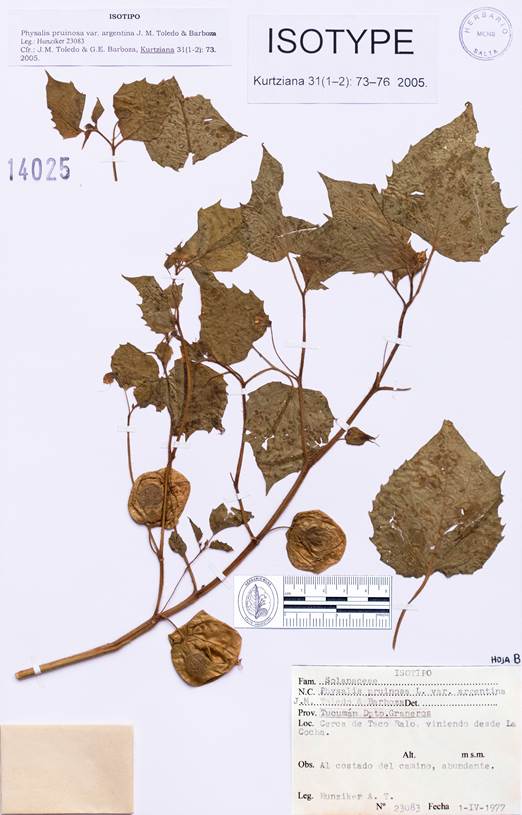
Figure 5. Isotype of Physalis pruinosa var. argentina J.M.
Toledo & Barboza
(MCNS 14025). Credit:
B. Rodríguez.
À Solanaceae
Physalis pruinosa var.
argentina J.M. Toledo &
Barboza in Kurtziana
31(1-2): 73. 2005.
Type: Isotype MCNS 14025. (Fig. 5) Collection data: Argentina. Tucumán: Dpto. Granero,
Cerca de Taco Ralo, viniendo
desde La Cocha al costado del camino.
1-IV- 1977. Hunziker
J. H. 23083.
Ref.: Toledo, J. M., & Barboza, G. E. (2005). Novedades en Physalis
(Solanaceae). Kurtziana 31(1-2), 69-85.
À Rubiaceae
Galianthe bisepala E.L. Cabral in Bonplandia 7(1–4): 4. 1993.
Type: Holotype MCNS 14003.
Collection data: Argentina. Salta: Dpto. La Viña, Quebrada
de las Conchas, entre la Salamanca
y el Hongo, RN 68 km 77-78, 1300 m s.n.m. 10-III-1990. Novara L. J. &
Bruno S. 9630.
Ref.: Cabral,
E. L. (1993). Novedades
en Galianthe (Rubiaceae). Bonplandia 7, 4-7.
CONCLUSIONS
The 29 nomenclatural types of the MCNS Herbarium
come mainly from the north- west region of Argentina, especially Salta, Jujuy and Tucumán provinces, and some of them from La Rioja and San Juan. The best represented families
are Bromeliaceae (six holotypes and one isotype)
and Juncaceae (one holotype
and two isotypes). These specimens, along with the rest of the collection, have a great scientific potential
and contribute to the
enrichment of the institutional heritage.
ACKNOWLEDGEMENTS
We thank researchers and students that contributed their collections, Bruno Rodríguez for digitalizing the specimens, and the authorities of the Facultad de Ciencias Naturales of Universidad Nacional de Salta for financing the maintenance of the collection.
REFERENCES
Davis, C. C. (2023). The herbarium of the future.
Trends in Ecology and Evolution, 8(5), 412–423.
Espeche, M., García, M.,
& Reyes, N. (2020). Estudio
palinológico preliminar en especies
de Erythrina (Fabaceae) presentes en Argentina. Lilloa,
57(2), 144-155. https://doi. org/10.30550/j.lil/2020.57.2/5
Fernández-Fernández, D., Freire M. E., Peñafiel, C. M., Romero,
G., Tello, F., & Toapanta, E. (2015).
Catálogo de especímenes tipo del Herbario Nacional del Ecuador (QCNE),
Museo Ecuatoriano de Ciencias
Naturales. Avances en Ciencias e Ingeniería, 7(1), 39- 87. https://doi.org/10.18272/aci.v7i1.227
Holmgren, P.
K., Holmgren, N. H., & Barnett,
L.C. (1990). Index Herbariorum. Part I, The Herbaria
of the World. Regnum
Vegetabile, Vol. 120, 8th edition. International Association for Plant Taxonomy. New York Botanical
Gardens. http://rs.tdwg.org/ih/doc/book/
Lira, R., García,
M. R., & Villaseñor, J. L. (1996). Catálogo
de ejemplares tipo del Herbario
Nacional de México
(MEXU). III. Compositae. Anales del Instituto de Biología, serie Botánica. 67(2), 385-417.
Novara, L. J. (1991) Introducción. Flora del Valle de Lerma. Aportes Botánicos de Salta, serie Flora, 181, 1-15.
Ocampo Acosta, G., & Medellín Villamil,
A. L. (2004). Catálogo de ejemplares tipo del herbario IEB (México). Acta Botánica Mexicana, 41(67), 1-41. https://doi. org/10.21829/abm67.2004.971
Peña Tamayo, J. E., & Jaramillo
Díaz, N. (2019) Catálogo de especímenes tipo del Herbario Reinaldo Espinosa (LOJA), Univ. Nac. de Loja. Bosques Latitud cero, 9 (2), 1-19.
Pandey, A. K., & Kasana, S. (2021).
Plant Systematics, 1er. ed. CRC Press. 340 pp. https://doi.org/10.1201/9781003183464
Peñuelas, J., & Matamala, R. (1993). Variations in the mineral
composition of herbarium plant species collected during the last three centuries. Journal of Experimental Botany, 44(9), 1523-1525. https://doi.org/10.1093/ jxb/44.9.1523